
The Kalahari
Regarded as one of the few remaining true wilderness areas in Africa, the Kalahari is the largest undisturbed arid sandy savannah on the continent. It stretches across nearly 930,000 square kilometres of Botswana, Namibia, and South Africa, forming part of the vast 1.5 million square kilometre Kalahari Basin; a region that also includes the Okavango Delta and Makgadikgadi Pans.
The Kalahari is the southernmost desert in Africa and the second largest on the continent after the Sahara. Due to its relatively higher average rainfall, it is not classified as a true desert but rather a semi-desert. Rainfall ranges from as little as 125 mm (5 inches) in the southwest to about 500 mm (20 inches) in the northeast. Yet even in these wetter areas, the deep red sands absorb and drain away most of the rainfall, leaving a strikingly dry landscape with little to no surface water.
Stretching across Botswana, Namibia, and South Africa, the Africa Kalahari is one of the world’s last great wildernesses. More than just a desert, it is a vast, semi-arid savanna of rolling red sands, ancient riverbeds, and surprisingly resilient life. This guide explores the unique habitats, wildlife, and conservation importance of this iconic landscape, and how you can experience it on an unforgettable South Africa safari trip.
Sense of Place
RED SAND AND WHITE PANS
While many imagine the Kalahari as endless red dunes, this describes only a fraction of the region. The Eastern Kalahari, home to !Khamab, is defined by subtle, undulating sandy plains and the iconic red sands.


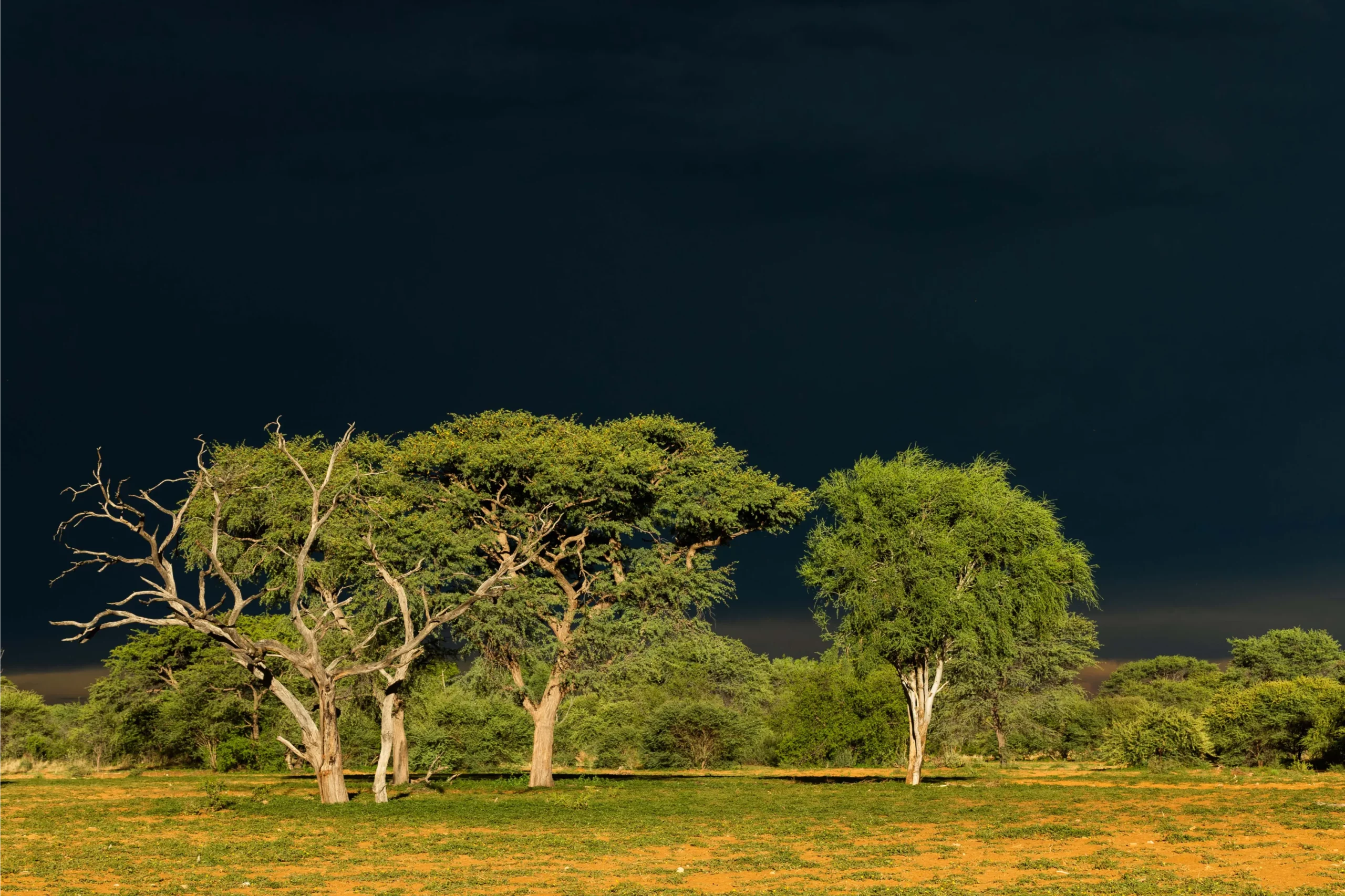


The landscape is punctuated only by scattered white calcrete pans, which act as vital focal points for wildlife congregation. The mosaic of red sand, white pans, yellow grasslands and camelthorn woodlands forms the quintessential Kalahari vistas that define the reserve.
A Land of Ephemeral Waters and Ancient Rivers
What distinguishes the Kalahari from a true desert is its rainfall, which averages more than 250 mm per year. However, with little to no surface water, it remains a largely waterless landscape for much of the year. Life here depends on the seasonal rains that fill numerous ephemeral pans. During the wet season, these pans can hold water for several weeks, becoming vital hubs of activity that attract hundreds of animals.
The Kalahari has often been described as the land of vanishing rivers. It is home to ancient drainage systems such as those in Deception Valley, and ephemeral rivers like the Molopo, Moselebe, Kuruman, Nossob, and Aoub; waterways that flow only during exceptionally wet periods. In fact, there has been no evidence of permanent flow in these southern rivers for the past 12,000 years. As a result, the species that inhabit this region have evolved remarkable adaptations to survive long stretches without surface water.
Fossilised riverbeds are common in the southern Kalahari. One such ancient river, the Phepane, once joined the Molopo system. A section of the Molopo River that once flowed through the area where !Khamab is now located changed its course between two and five million years ago. Its remnants are still visible today as a chain of pans running southwest through the reserve, a living trace of the Kalahari’s deep geological past.
A Spectacle of Kalahari Wildlife and Flora
Some species have become almost synonymous with the Kalahari. Think of the Kalahari and in your mind automatically wanders to regal gemsbok, black-maned lion, curious meerkat, magnificent camelthorn trees and croaking black korhaan! Although all these species can also be found elsewhere, there is something special about seeing them in the semi-desert of the Kalahari. For an arid savanna, it is densely covered, and the variety of species that call the Kalahari home is second to none, making it the destination for what many consider the best safari South Africa has to offer.
Resilient
Flora
The Kalahari has the lowest plant species to area ratio when compared to other regions of southern Africa, despite the variation in rainfall across the region. Floristically, it is regarded as lacking in a variety of species and has few endemics. For an arid savanna, it is quite densely covered with grasses, shrubs and trees. The lack of variety should not take anything away from some of the distinctive species of the Kalahari.
Distinctive flora ranges from impressive camelthorn and shepherd’s trees to shrubs like raisin and puzzle bush, and plains covered by bushman’s grass. The Kalahari is also home to many creeping plant species like tsamma melon and gemsbok cucumber. These plants provided food and water to early San inhabitants and many animal species during dry periods, while the unique devil’s claw has many medicinal uses.
Distinctive
Kalahari Wildlife
Few animal species epitomise the image of the Kalahari quite like the famed black-maned lions or the majestic gemsbok. As with the floral component, the Kalahari also has few endemic fauna species. But the variety of species that call the Kalahari home is second to none. Apart from lions, other predators such as leopards, spotted hyena, brown hyena and the endangered African wild dog and cheetah live here. Coupled with herbivore species such as eland, blue wildebeest, red hartebeest, springbok, giraffe, zebra and even elephant and rhino in the north and east, the Kalahari provides a wildlife spectacle like few other places in Africa.
Despite the Kalahari being called a predator’s paradise, as many species of large and small predators call it home, they are elusive, and sightings of many of these species remain rare, but always special.
Birdlife
The Kalahari is also well known for its raptors, and !Khamab provides a place where many can soar in the skies. The reserve provides a safe place where two vulture species, the white-backed and lappet-faced vultures, can build their nests in tall camelthorn or shepherd’s trees. Other common raptors include bateleur, secretary bird and several eagle, owl, falcon, goshawk and kite species. The reserve is also home to other birds that are synonymous with the Kalahari. This includes the largest bird in the world, the ostrich, and the heaviest flying bird, the kori bustard. In total, 218 bird species have been recorded on !Khamab, although many are migratory and not present on the reserve permanently.
Kalahari
pans
An outstanding feature of the Eastern Kalahari Bushveld is the presence of endorheic pans of varied sizes scattered throughout the landscape. The floors of these pans are covered with short grasses and dwarf shrubs, which provide food to short grass grazers and browsers alike. Notably, springboks use them almost exclusively at times. During wet periods, these pans often keep water for several weeks, which serves as important water sources to the typical adapted Kalahari species. This, and the high nutrient composition of the soils, at times attracts large numbers of ungulates of various species, providing a true wildlife spectacle.
Giants of
the Savanna
!Khamab’s proximity to the Molopo River puts the current location of the reserve in the historic migration routes of many species that moved south and west, following the river course, before human presence prevented further migration. With permanent water now supplied on the reserve, small populations of elephant, buffalo, black- and white rhino can now be sustained permanently on the reserve.
Why This Wilderness Matters
The Kalahari was once an open system where vast herds were free to migrate, following thunderstorms into areas of higher seasonal rainfall. Permanent human settlement was largely excluded before the 1940s due to the lack of surface water and the technology to access deep subterranean sources. This allowed natural animal movements to occur until fairly recently. !Khamab’s location along the Molopo suggests that it would have historically experienced the movement of most typical Kalahari species into and through the area.
As technology improved, agricultural activities and fences increased, preventing the natural movement of wildlife. Over time, the area available to wildlife shifted further north into Botswana towards the central areas of the Kalahari. This happened all along the outer edges of the Kalahari basin, resulting in many diverse fauna species of the Kalahari being limited to a few natural areas. This history is what drives the conservation strategy of !Khamab.
By creating a large reserve free of internal fences, we in part restored some of the ecological processes that were disrupted, and returned many wildlife species to their former range. As one of the largest game reserves in South Africa, our scale is our strength. It allows us to make a meaningful contribution to protecting the Kalahari ecosystem, its historic migration routes, and its full spectrum of wildlife.

PLAN YOUR KALAHARI ADVENTURE
To experience the magic that the Kalahari offers, contact us for a tailor-made safari. A visit to !Khamab is more than just a South African safari trip; it is an exclusive and intimate journey into the heart of a truly wild place.
!Khamab offers three distinct styles of wildlife accommodation, from classic expedition style tents to luxurious lodges. As we host only a small number of guests, you have the privilege of exploring the game reserve with your guide while hardly encountering other visitors. This creates a truly intimate and private wilderness experience, adding to the profound feeling of remoteness that the Kalahari provides.